Introduction
A spark plug is smaller than most people’s thumb, costs a few dollars, and yet without it your engine wouldn’t start at all. That gap between “how small it is” and “how much it matters” is what makes it worth actually understanding rather than just replacing on schedule without knowing why.
I’ve explained this to plenty of people leaning over an open hood, and it always clicks once you stop thinking of it as an electrical part and start thinking of it as a tiny, precisely-timed lightning bolt generator. That’s genuinely what it is. Here’s exactly what’s happening every time your engine fires.
The Quick Answer
A spark plug takes a short burst of very high-voltage electricity from the ignition coil and uses it to jump a small gap between two electrodes, creating a spark. That spark ignites the compressed air-fuel mixture inside the engine’s cylinder, which is the explosion that actually pushes the piston down and makes the engine run. It happens dozens of times per second, in every cylinder, every time the engine is running.
The Anatomy of a Spark Plug
Before the sequence makes sense, it helps to know what you’re actually looking at when you hold one. A spark plug is a simple-looking part with a few components each doing a specific job:
- Terminal — the top connector where the ignition coil or spark plug wire attaches, delivering the high-voltage charge.
- Insulator — the ceramic body running most of the plug’s length. Its job is to keep that high voltage contained and directed down through the center electrode rather than arcing out somewhere it shouldn’t.
- Metal shell (hex) — the threaded outer casing that screws into the cylinder head, grounds the plug to the engine, and gives you something to grip with a socket.
- Center electrode — the rod running down the middle of the insulator, carrying the voltage to the very tip.
- Ground electrode — the small curved piece of metal at the base, positioned a precise distance from the center electrode.
- The gap — the small air space between the center and ground electrodes where the actual spark jumps across.
That gap is the entire point of the design. Get it wrong — too wide or too narrow — and everything downstream of it suffers, which is why gap measurement is a real step in installation rather than a formality.
What Actually Happens, Step by Step
1. The ignition coil builds voltage. Your car’s battery only supplies 12 volts, which isn’t nearly enough to create a spark that can jump a gap. The ignition coil acts as a transformer, taking that 12 volts and stepping it up dramatically — often into the tens of thousands of volts — in a fraction of a second.
2. That voltage reaches the spark plug’s terminal. Depending on your engine’s ignition system, this happens through a spark plug wire or, in most modern cars, a coil mounted directly on top of the plug (a “coil-on-plug” setup), timed precisely by the engine’s computer.
3. Voltage builds at the center electrode until it overcomes the gap. Air is normally a poor conductor of electricity — that’s exactly why there’s a gap there rather than direct contact. As voltage keeps climbing, it eventually becomes strong enough to force its way through that air, momentarily turning it into a conductive path.
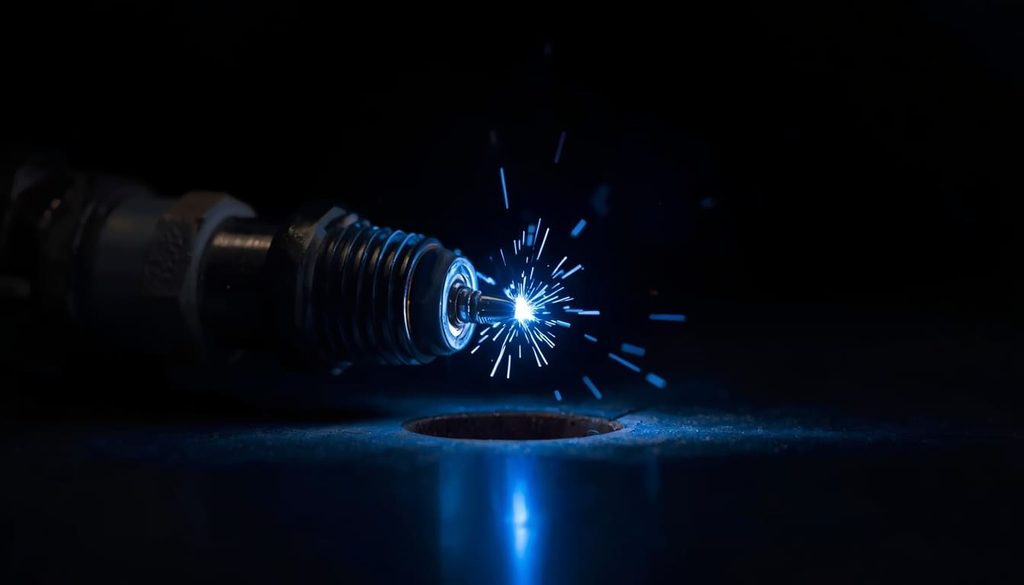
4. The spark jumps. The moment the voltage overcomes the air’s resistance, electricity arcs across the gap from the center electrode to the ground electrode. This happens almost instantly, and it’s genuinely a tiny, controlled lightning bolt — the same basic physics as a much larger natural spark, just scaled down and precisely timed.
5. The spark ignites the air-fuel mixture. At the exact moment the piston has compressed air and fuel into a small space in the cylinder, that spark sets it off. The resulting rapid combustion expands violently, driving the piston back down — this is the actual power stroke that turns the crankshaft and makes the engine run.
6. This repeats, continuously, for every cylinder. A four-cylinder engine at highway speed is firing each spark plug dozens of times per second. The entire sequence above happens with a level of consistency and timing precision that’s easy to take for granted until a plug starts failing.
Why It Takes So Much Voltage
This is the part people find counterintuitive: why does something as small as a spark plug need tens of thousands of volts, when household electronics run on so much less? The answer is entirely about that air gap. Air is an insulator — it actively resists letting electricity pass through it, which is exactly why you can stand near household wiring without getting shocked from a few inches away.
To force a spark across even a small gap, you need enough voltage to overcome that resistance and briefly turn the air into a conductor. The wider the gap or the higher the compression pressure inside the cylinder, the more voltage it takes to make that jump. This is also why a worn spark plug with a gap that’s widened over time makes your ignition system work harder than it should — it’s not just “less efficient,” it’s asking for more voltage than the system was designed to comfortably supply on a consistent basis.
What Happens to the Spark Plug After the Spark
The spark plug’s job doesn’t end the instant it fires. It also sits directly in the combustion chamber for the rest of that cycle, absorbing intense heat from the explosion it just triggered, and it has to shed that heat fast enough to avoid overheating before the next cycle starts. This heat-management property is called the plug’s “heat range,” and it’s engineered specifically for your engine’s combustion characteristics — running the wrong heat range for your engine is a separate issue from normal wear, and one worth getting right rather than guessing at.
The plug also has to survive that repeated combustion, thousands of times, without the electrode eroding away too quickly. This is where the metal used at the tip — copper, platinum, or iridium — actually matters, since each one handles that repeated electrical and thermal stress differently. If you’re deciding which material makes sense for your car, our comparison of iridium vs platinum vs copper spark plugs breaks down exactly how that trade-off works.
What Happens When This Process Starts Failing
Understanding the mechanism also explains why a struggling spark plug causes the exact symptoms it does. If the gap has widened from wear, the voltage needed to jump it increases — and if the ignition coil can’t quite keep up, you get an inconsistent or weak spark, which shows up as a rough idle, hesitation, or a misfire code. If deposits build up on the electrode tip, they can partially short-circuit the spark before it even has a chance to jump the gap correctly.
If you’re noticing sluggish acceleration and wondering whether this is the actual cause, our guide on how spark plugs affect acceleration connects those symptoms directly back to this ignition process. And if a plug is failing well before it should based on mileage alone, it’s worth checking whether it’s simply worn out or whether the wrong plug was installed in the first place — our guide to wrong spark plug symptoms explains how to tell the difference.
How Long This Process Keeps Working Reliably
Every time a spark plug fires, a microscopic amount of metal erodes from the electrode tip — that’s simply the physical cost of generating a spark this way, repeated tens of thousands of times per mile driven. Over time, that erosion widens the gap and dulls the spark’s efficiency, which is exactly why spark plugs are a wear item rather than a permanent part. How long that takes depends heavily on the electrode material and your driving conditions — our full breakdown on how long spark plugs actually last covers the real mileage ranges by type, and this guide on how often to change spark plugs covers when to actually plan the replacement.
FAQs
Do all spark plugs work the same way, regardless of type or brand?
The core mechanism — high voltage jumping a gap to ignite the air-fuel mixture — is identical across every spark plug. What differs between types and brands is the electrode material, tip design, and heat range, which affect how efficiently and how long that same basic process performs.
Why does a spark plug need a gap instead of the electrodes just touching?
If the electrodes touched, electricity would flow continuously rather than building up enough energy to create a strong, concentrated spark. The gap forces the voltage to build until it’s powerful enough to jump across, which is what produces a spark hot and focused enough to reliably ignite compressed fuel and air.
Can a spark plug work without an ignition coil?
No. The spark plug itself doesn’t generate voltage — it only directs and discharges the high voltage the ignition coil supplies. Without the coil stepping up the battery’s voltage, there wouldn’t be enough electrical pressure to create a spark at all.
Why do diesel engines not use spark plugs the same way gasoline engines do?
Diesel engines rely on compression alone to ignite fuel, generating enough heat from compression to combust without a spark. Some diesel engines use glow plugs instead, which preheat the combustion chamber for easier cold starts, but they work on a completely different principle than a gasoline spark plug.
Does a stronger spark always mean better engine performance?
Not necessarily beyond a certain point. What matters most is a consistent, correctly-timed spark that matches your engine’s design. A spark that’s too weak causes misfires, but simply maximizing spark strength beyond what the engine calls for doesn’t provide a meaningful performance benefit on its own.
The Bottom Line
A spark plug’s entire job comes down to one precise, repeated action: take a burst of high voltage, force it across a small gap, and use the resulting spark to ignite compressed fuel and air at exactly the right moment. It’s a simple concept executed with a huge amount of precision, thousands of times per minute, for as long as your engine runs. Understanding that mechanism is what makes the rest of spark plug maintenance — gap, material, heat range, replacement timing — actually make sense instead of feeling like arbitrary numbers on a chart.