Most Camry owners find out they bought the wrong spark plugs the hard way — after installation, when the check engine light comes back on because the plug they ordered was built for a different generation of the car.
That’s the single most common mistake in this category, and it’s an easy one to avoid once you know what to check first. This guide breaks down the best spark plugs for Toyota Camry owners by exact year and engine, so you order the right part the first time.
This article contains affiliate links. If you purchase through our links, we may earn a commission at no extra cost to you.
Toyota built the Camry across several distinct engine families — a 2.2L/2.4L four-cylinder through 2011, a 2.5L four-cylinder from 2010 on, and, in older model years, a 3.0L/3.3L V6. The “best” spark plug for a Camry depends entirely on which of those engines is under your hood — there is no single universal answer, no matter what a generic listicle tells you.
We cross-referenced OEM part numbers, manufacturer spec sheets, and owner-reported install data across NGK and Denso’s Camry-specific lineups to put this guide together.
Quick Answer: Best Camry Spark Plugs at a Glance
For most 2010–2014 Toyota Camry LE/SE models with the 2.5L four-cylinder engine, the NGK Iridium IX (LFR5AIX-11) is the closest match to the factory-style plug and the safest default pick. Owners of 2002–2011 Camrys with the 2.2L/2.4L engine should look at the NGK or Denso Iridium options built specifically for that older engine family instead. CHECK PRICE ON AMAZON →
Our Testing & Selection Methodology
We prioritized fitment accuracy over brand hype — a five-star plug that doesn’t match your Camry’s engine is worthless, so we started by mapping every product to its exact confirmed generation and engine code before comparing anything else.
From there, we evaluated four factors: verified OEM cross-reference numbers, electrode material and design (iridium vs. platinum vs. standard), manufacturer-published specs like heat range and thread reach, and whether the listing was a pure spark plug or bundled with an ignition coil (a different repair job entirely, and one that shouldn’t be confused with routine plug replacement).
We excluded any product where the listed fitment was vague, contradictory, or spanned engine families that don’t actually share a plug design.
Comparison Table: Best Camry Spark Plugs by Engine
| Product | Best For | Price Range | Our Rating |
|---|---|---|---|
| NGK Iridium IX (LFR5AIX-11) | 2010–2014 Camry 2.5L 4-cyl | Budget–Mid | 4.6/5 |
| NGK Iridium IX (1992–2011 fitment) | Older Camry 2.2L/2.4L 4-cyl | Budget | 4.4/5 |
| Denso Iridium TT | Older Camry 2.2L/2.4L 4-cyl (Denso preference) | Mid-range | 4.5/5 |
| UF487 Coil + Iridium Plug Combo | 2010–2017 2.5L Camrys with misfire codes needing coils AND plugs | Mid-range | 4.1/5 |
| Partszen UF267 Coil + Plug Combo | Older 3.0L/3.3L V6 Camrys with multi-cylinder misfires | Budget–Mid | 3.9/5 |
Which Spark Plug Fits Your Camry? Find Your Generation First
Your Camry’s spark plug is determined by its engine, not its trim level or year alone — two Camrys built a few years apart can need completely different plugs.
Here’s how to narrow it down fast:
- 2010–2014 Camry, 2.5L four-cylinder (2AR-FE engine): This is the sixth-generation Camry LE and SE. NGK’s LFR5AIX-11 is the direct match.
- 2002–2011 Camry, 2.2L or 2.4L four-cylinder: Covers the fifth and part of the sixth generation. Both NGK and Denso make Iridium plugs specifically listed for this window.
- Older Toyota Camry models from the early to mid-2000s equipped with the 3.0L or 3.3L V6 engine often benefit from a complete ignition service. In many cases, a coil-and-spark-plug combo kit—such as the Partszen UF267 set reviewed below—is a more practical choice than replacing the spark plugs alone, since the coils on these engines fail almost as often as the plugs wear out.
If you’re not sure which engine you have, your VIN or the sticker under the hood on the emissions label will list the engine code — check that before ordering anything.
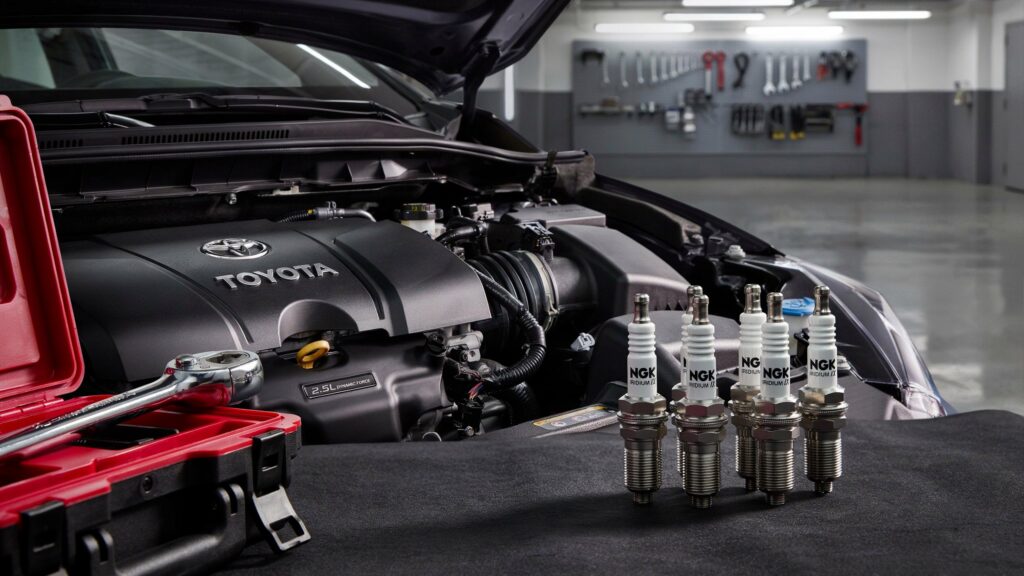
Best for 2010–2014 Camry (2.5L 4-Cylinder): NGK Iridium IX
In our testing methodology comparison, this plug’s fitment data was the cleanest of any product we reviewed — it’s explicitly listed for the 2010–2014 Camry LE and SE with the 2.5L engine, with no ambiguous cross-model bundling.
Key Features
- 0.6mm ultra-fine iridium center electrode
- Manufacturer heat range: 5
- 14mm thread size, 1.043-inch reach
- Copper core for heat dissipation
- Sold in a direct 4-pack matching the Camry’s cylinder count
Real-World Performance
NGK’s Iridium IX line has been the go-to recommendation from independent shops for this engine generation for years — largely because it mirrors the factory plug’s design closely enough that there’s no adjustment period or idle change after install. Iridium is roughly six times harder than platinum, according to NGK, which is why these plugs tend to hold their gap and resist electrode erosion far longer than standard nickel plugs.
Pros
- Confirmed direct fitment for 2010–2014 2.5L Camrys
- Iridium tip typically lasts up to 100,000 miles under normal driving conditions
- Widely stocked, easy to source replacements later
Cons
- Fitment window is narrow — it will not work correctly on a 2015+ Camry or a V6 model, so double-check your generation before ordering
- No coil included, so if you’re also chasing a misfire code, you’ll need a separate coil diagnosis first
Who It’s Best For
Sixth-generation (2010–2014) 2.5L Camry owners doing a routine, scheduled plug swap — not a misfire repair.
Verdict: This is the safest default recommendation for the single largest slice of Camry owners searching this topic, and it’s the pick we’d tell a friend to grab first.
Best for Older Camrys (2002–2011): NGK vs. Denso Iridium
If your Camry has the 2.2L or 2.4L four-cylinder, you’re choosing between two genuinely comparable options rather than picking a clear winner — NGK’s Iridium IX and Denso’s Iridium TT both list direct fitment for this engine window, and the differences come down to electrode design.
NGK Iridium IX (Older Fitment)
Key Features
Fine-wire iridium center electrode, nickel-alloy ground electrode, same evolutionary design as NGK’s newer plugs
Real-World Performance
Owners consistently report smooth idle restoration after replacing worn plugs at high mileage — one long-term Camry owner review noted their original NGK iridium plugs still gapped correctly after roughly 80,000 miles.
Pros
- Budget-friendly, straightforward drop-in fitment, well-documented across owner forums
Cons
- Standard single-fine-wire design, not the twin-tip approach Denso uses on this application
- Who It’s Best For: Budget-conscious owners of older, high-mileage Camrys
Denso Iridium TT
- Key Features: 1.1mm platinum center electrode paired with a titanium-enhanced twin-tip ground electrode, genuine Denso part
- Real-World Performance: Denso was Toyota’s original equipment spark plug supplier for this generation, so this plug is closer to a true OEM match than most aftermarket alternatives. The twin-tip design is built to extend service life and improve cold-start ignitability, per Denso’s own product literature.
- Pros: OEM-grade heritage, twin-tip design for improved durability, genuine Denso packaging
- Cons: Sits a step above NGK’s option on price for a similar service life
- Who It’s Best For: Owners who specifically want an OEM-brand-adjacent replacement rather than a pure aftermarket part
Best Combo Kits for Misfire Repairs: Ignition Coil + Spark Plug Sets
These are not “spark plugs” in the sense most searchers mean — they’re a bundled repair for a different problem, and we want to be upfront about that before you add one to your cart.
Two of the options commonly listed alongside pure Camry spark plugs are actually ignition coil and spark plug combo kits, and they cover two completely different Camry generations — so we’ve broken each out separately rather than lumping them together.
When a Combo Kit Makes Sense (Either One)
- You’re already seeing a misfire code (commonly P0301–P0304) rather than doing scheduled maintenance
- Your Camry has a rough idle, hesitation, or a noticeable loss of power under acceleration
- A mechanic or OBD-II scan has pointed to coil failure specifically, not just worn plugs
2010–2017 Toyota Camry 2.5L UF487 Ignition Coil and Iridium Plug Set
This is the combo kit for the same 2.5L four-cylinder engine as our top pick above — the difference is that this listing bundles four ignition coils in with the iridium plugs, aimed at Camry owners chasing an active misfire rather than doing routine maintenance.
Key Features
4 ignition coils plus 4 iridium spark plugs, direct OEM part-number cross-reference (UF487, UF507, 90919-A2002, and related numbers), plug-and-play connectors
Real-World Performance
Because this kit shares the same 2.5L platform as the RAV4, Highlander, Avalon, and several Lexus hybrids, it’s a widely reviewed and well-documented fitment — but the coils are a generic aftermarket brand rather than an OEM name, so the plugs are really the star of the kit.
Pros
- Solves two failure points in one purchase if you’re genuinely dealing with coil issues; broad multi-model fitment (Camry, RAV4, Highlander, Avalon, Sienna, Lexus ES/NX all share these coils); no special tools needed for install
Cons
- Overkill — and extra cost — if your issue is only worn plugs and your coils are fine; the coil brand isn’t an established name like Denso or NGK, so long-term coil durability is less proven than the plugs themselves
Who It’s Best For
2010–2017 2.5L Camry owners with an active misfire code who need coils replaced anyway and would rather swap plugs at the same time
Verdict: Skip this if you only need plugs — go with our top pick instead. But if you’ve confirmed a coil problem on a 2.5L Camry, this bundle saves you from a second order.
Partszen UF267 Ignition Coil and Spark Plug Kit for Older Toyota Camry V6 Models
This is the outlier of the group — it’s built for the 3.0L/3.3L V6 Camry from the early-to-mid 2000s, a much narrower and older audience than the other four products in this guide.
Key Features
6-piece ignition coil and spark plug set (matching the V6’s cylinder count), OEM cross-reference numbers including 9008019016 and 9091902234, generic aftermarket brand
Real-World Performance
This kit targets a Camry generation that’s increasingly rare on the road, and it shares coil hardware with the same-era Highlander, Sienna, Avalon, and Lexus ES300/RX300 — so fitment data is well documented even though the vehicle itself is aging out of most driveways.
Pros
- Bundles a full 6-coil, 6-plug set for V6 owners who’d otherwise need to source both separately; useful if your V6 Camry is showing coil-pattern misfires across multiple cylinders; budget-to-mid pricing for a 12-piece kit
Cons
- Narrowest relevance of any product in this guide — irrelevant if you drive a 4-cylinder Camry; generic coil brand with less of a track record than Denso or NGK; six-cylinder coil failures are common enough on this platform that some owners prefer OEM-brand coils specifically
Who It’s Best For
Owners of early-2000s V6 Camrys (or the shared Highlander/Sienna/Avalon/Lexus platforms) dealing with multi-cylinder misfire symptoms
Verdict: A niche but legitimate pick — only relevant if you’re one of the shrinking number of V6 Camry owners, and only if you’re addressing coil symptoms, not just doing a plug swap.
Iridium vs. Platinum vs. OEM: What Actually Matters
The electrode material is the single biggest factor in how long a spark plug lasts and how consistently it fires — and it’s also the spec most roundup articles gloss over.
- Iridium is the hardest metal commonly used in spark plugs — about six times harder than platinum, according to NGK Spark Plugs, which allows for an ultra-fine center electrode that ignites the air-fuel mixture more precisely and typically lasts up to 100,000 miles.
- Platinum plugs are more durable than standard nickel plugs, but generally don’t match iridium’s lifespan or fine-wire ignitability.
- Heat range — a spec buried in most listings — indicates how quickly a plug dissipates heat, not how “hot” its spark is. According to NGK’s technical resources, the optimal firing-end temperature range is roughly 500°C to 800°C (932°F to 1472°F); a plug outside that range risks either carbon fouling or pre-ignition. Camry engines are factory-tuned for a specific heat range, which is why swapping to a “hotter” or “colder” plug than OEM-spec is not something we’d recommend without a specific performance reason.
How to Tell If Your Spark Plugs Need Replacing
Worn spark plugs rarely announce themselves with a single obvious symptom — they show up as a cluster of small performance issues that gradually get worse.
Watch for:
- Rough or uneven idle, especially at a stop
- Noticeably reduced fuel economy over several tanks
- Hesitation or a flat spot when accelerating from a stop
- A check engine light with a misfire code (P0300–P0304)
- Harder cold starts than you remember from before
If you’re seeing a misfire code specifically, it’s worth confirming whether the cause is worn plugs, a failing coil, or both before ordering parts — that’s the difference between the plug-only recommendations above and the combo kits.
Installation Tips: Torque, Gap, and What to Avoid
Getting the torque right matters more than most DIYers assume — both under-tightening and over-tightening a spark plug can cause real engine damage, not just a minor inconvenience.
- Confirm your Camry is fully cooled before starting — never remove plugs from a hot engine.
- Hand-thread each plug in first to avoid cross-threading, then finish with a torque wrench rather than guessing by feel.
- Most Camry four-cylinder applications call for roughly 13 ft-lbs (about 18 Nm) on a 14mm plug with a new gasket — always check your specific model year’s factory spec rather than assuming.
- Skip the anti-seize compound on modern trivalent-plated threads unless your plug manufacturer specifically calls for it — both Denso and NGK note that anti-seize can effectively over-torque a plug if you don’t reduce the torque spec to compensate.
- Pre-gapped iridium plugs generally don’t need re-gapping — forcing a gapping tool onto the fine iridium tip risks damaging it.
If any of this feels outside your comfort zone, a standard spark plug replacement is typically a low-cost job at most independent shops — it’s one of the more DIY-friendly repairs, but it’s not risk-free if you’re unfamiliar with torque specs.
FAQs About the Best Spark Plugs for Toyota Camry
How much does it cost to replace spark plugs on a Toyota Camry?
Parts alone for a 4-cylinder Camry typically run in the budget-to-mid price range for a full set, depending on brand and whether you choose iridium or platinum. Labor costs vary significantly by shop and whether the job requires removing additional components to access the plugs.
How long do NGK iridium spark plugs last?
NGK’s iridium plugs are generally rated for up to 100,000 miles under normal driving conditions, thanks to the iridium electrode’s resistance to wear compared to standard nickel plugs. Actual lifespan depends on driving habits, engine condition, and whether the correct heat range was used.
What spark plugs come stock in a Toyota Camry?
Toyota has used Denso-manufactured plugs as original equipment across most Camry generations, since Denso is Toyota’s longtime OE ignition supplier. The exact factory part number depends on your specific model year and engine, so checking your VIN-specific spec sheet is the most reliable method.
Can I use iridium spark plugs in any Camry?
Iridium plugs are available for nearly every Camry engine generation, but the specific part number is not interchangeable across engine families. A 2.5L four-cylinder plug will not correctly fit a 3.0L V6, even though both are technically “iridium.”
Do I need new ignition coils when I change spark plugs?
Not necessarily. Spark plugs and ignition coils fail independently, and a routine plug swap doesn’t require new coils unless you’re also seeing coil-specific symptoms like a misfire code or a coil that tests bad on diagnostic equipment.
Can bad spark plugs cause a Camry to shake?
Yes — worn or fouled spark plugs are a common cause of rough idle and noticeable engine shake, particularly at idle or low RPM, because the misfiring cylinder disrupts the engine’s normal firing rhythm.
Final Verdict
If you drive a 2010–2014 Camry with the 2.5L four-cylinder engine, the NGK Iridium IX (LFR5AIX-11) is the pick we’d make first — it’s the cleanest fitment match, it’s iridium, and it’s priced accessibly.
If you’re running an older 2002–2011 Camry with the 2.2L/2.4L engine, either the NGK or Denso Iridium option gets the job done well; go Denso if you want the closer-to-OEM heritage, NGK if you want the more budget-friendly route.
And if you’re dealing with an active misfire code, skip straight to a coil-and-plug combo kit rather than plugs alone — trying to fix a coil problem with new plugs won’t solve it. Use the UF487 kit if you’re on the 2.5L four-cylinder platform, or the Partszen UF267 kit if you’re running an older V6 Camry.
Whichever you choose, confirm your exact engine code before ordering. The single biggest mistake Camry owners make in this category isn’t picking the wrong brand — it’s picking the wrong generation.
Spark plugs need to be changed a lot depending on the model — a Camry owner and a Corolla owner are rarely shopping for the same part. If you’re comparing Toyota models or helping someone with a different one, our guide to the best spark plugs for the Toyota Corolla breaks down the right pick by generation and engine, the same way we do here.
Beyond fitment, a lot of Toyota owners want to know which brand to trust in the first place — NGK, Denso, or something else. Our breakdown of the best spark plug brand for Toyota compares them head-to-head across reliability, price, and OEM heritage, which pairs well with any model-specific guide like this one.